
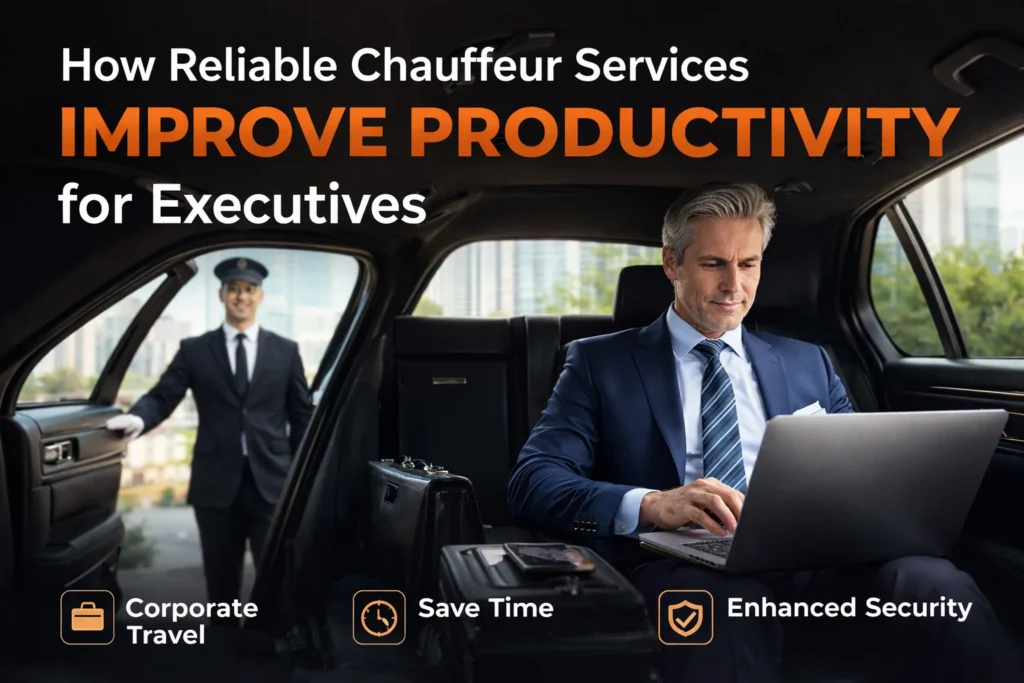
In executive leadership, time is not simply a resource — it is a strategic asset. Senior leaders operate in compressed schedules filled with investor meetings, board sessions, client negotiations, and high-value decision cycles. In this environment, unreliable transportation is more than an inconvenience; it is a productivity liability.
The measurable corporate chauffeur benefits of a structured transportation program extend far beyond comfort. A properly managed executive limo service transforms travel into protected work time, reduces cognitive strain, enhances punctuality, and reinforces corporate authority. When integrated correctly, a professional car service becomes part of an organization’s productivity infrastructure.
The Executive Productivity Problem
Executives face operational pressures that most employees do not:
- Back-to-back meetings across multiple locations
- Airport transfers tied to rigid flight schedules
- High-stakes negotiations with no margin for delay
- Confidential calls requiring secure environments
- Event-based travel surges
Unlike casual travel, executive mobility must be proactive. According to research from the Texas A&M Transportation Institute, congestion in major metropolitan areas costs commuters dozens of hours annually. For executives in business hubs, those hours translate into lost strategic output.
Even minor inefficiencies compound:
- Delays disrupt negotiation momentum
- Stress reduces cognitive clarity
- Parking and routing decisions drain mental energy
- Reactive travel increases decision fatigue
Reliable executive transportation addresses these friction points systematically.

What Are Corporate Chauffeur Benefits?
Corporate chauffeur benefits refer to the measurable productivity, security, and operational advantages companies gain by implementing structured executive transportation programs instead of relying on ad-hoc rideshare or self-driving.
These benefits typically include:
- Predictable arrival times
- Flight tracking integration
- Background-checked chauffeurs
- Confidential travel environments
- Centralized billing and reporting
- Route optimization and traffic monitoring
When evaluated through a productivity lens, these elements directly affect executive output.
Converting Transit Time into Strategic Work Time
One of the most immediate advantages of a professional car service is time reclamation.
In a rideshare or self-drive scenario, executives cannot safely:
- Review confidential contracts
- Conduct uninterrupted video conferences
- Prepare presentation notes
- Respond to sensitive emails
By contrast, an executive limo service provides:
- Quiet, controlled cabin space
- Optional onboard Wi-Fi
- Professional discretion
- Reduced interruption risk
This transforms travel into a mobile workspace.
If an executive reclaims just 30 minutes per trip for productive activity — contract review, investor briefing preparation, or team coordination — the cumulative annual impact becomes substantial.
Travel ceases to be downtime. It becomes structured work time.
Reducing Cognitive Load and Decision Fatigue
High-level leaders make hundreds of consequential decisions weekly. Research in behavioral science consistently shows that decision fatigue reduces judgment quality over time.
Driving in congested traffic requires constant micro-decisions:
- Lane changes
- Route recalculations
- Parking strategy
- Timing adjustments
Each of these consumes cognitive bandwidth.
A reliable executive limo service removes those decisions from the executive’s workload. Chauffeurs manage:
- Dynamic routing
- Traffic avoidance
- Airport terminal logistics
- Parking and drop-off strategy
This offloading preserves mental clarity for strategic thinking.
Cognitive conservation is one of the most underestimated corporate chauffeur benefits.
Ensuring Punctuality in High-Stakes Environments
At the executive level, punctuality is credibility.
Board meetings, investor briefings, legal proceedings, and merger negotiations are not flexible events. Delays can signal disorganization or lack of control.
Professional car service providers typically deploy:
- Real-time GPS monitoring
- Flight tracking systems
- Pre-assigned chauffeurs
- Dispatch coordination centers
- Backup routing plans
Rather than reacting to delays, structured services anticipate them.
For executives, punctual arrival reduces stress and reinforces authority before the meeting even begins.
Enhancing Confidentiality and Security
Executives frequently discuss sensitive matters during transit:
- Financial results
- Acquisition targets
- Litigation strategies
- Personnel decisions
- Strategic partnerships
A standard rideshare environment does not provide structured confidentiality protocols.
By contrast, executive limo services often include:
- Background-screened chauffeurs
- Commercial licensing standards
- Confidentiality expectations
- Professional conduct training
- Discreet vehicle presentation
For C-suite leaders and board members, this controlled environment enables secure communication between destinations.
Confidentiality is not a luxury — it is a governance requirement.
Improving Pre-Meeting Preparation and Performance
The minutes leading up to a high-stakes meeting significantly influence its outcome.
Executives require:
- Mental clarity
- Message alignment
- Strategic positioning
- Composure
Arriving after stressful traffic or rushed parking undermines performance.
A professional car service creates a transitional buffer between commitments. During this window, executives can:
- Rehearse negotiation strategy
- Conduct pre-brief calls
- Review presentation materials
- Refocus attention
This decompression space enhances performance quality.
Supporting Multi-City Executive Operations
Many executives operate across multiple cities within compressed timelines. Coordinating ground transportation separately in each location increases risk and administrative burden.
Structured executive limo service networks provide:
- Centralized booking systems
- Standardized service quality
- Consistent vehicle standards
- Consolidated billing
- Corporate account management
For enterprises managing frequent leadership travel, this continuity ensures predictable mobility standards nationwide.
Mobility becomes infrastructure rather than improvisation.
Minimizing Travel Disruptions
Travel volatility is inevitable:
- Flight delays
- Weather disruptions
- Terminal changes
- Road closures
The difference lies in response management.
Professional car service providers integrate:
- Real-time flight monitoring
- Dynamic dispatch updates
- Chauffeur standby coordination
- Alternate routing strategies
Instead of executives troubleshooting logistics mid-flight, the transportation team adapts in real time.
This protects productivity and reduces stress.
Reducing Physical Fatigue
Frequent travel contributes to executive burnout. Driving after:
- Long-haul flights
- International business trips
- Late corporate events
increases fatigue and compromises next-day decision quality.
Executive limo service allows leaders to:
- Rest between engagements
- Hydrate and recover
- Decompress before arrival
Energy preservation directly influences strategic output.
Sustained performance depends on physical recovery.
Creating Predictable Cost Structures
A common misconception is that rideshare is inherently more economical. However, hidden productivity costs shift the analysis.
Corporate chauffeur benefits include:
- Transparent billing
- Flat-rate or hourly pricing
- No surge fluctuations
- Simplified expense reporting
- Centralized invoicing
For finance teams, this predictability supports budgeting accuracy. For executives, it eliminates administrative friction.
Time saved on expense management is also productivity gained.
Executive Limo Service vs. Reactive Transportation
A structured comparison clarifies the distinction:
Reactive Transportation
- On-demand availability
- Variable driver standards
- Surge pricing
- Limited confidentiality
- Self-managed delays
Executive Limo Service
- Pre-scheduled and structured
- Professionally trained chauffeurs
- Transparent pricing
- Confidential environment
- Proactive dispatch management
Executives require reliability aligned with strategic responsibilities — not transportation that “might” be available.
Quantifying the Productivity ROI
Consider a conservative scenario:
- 1 hour of travel per day
- 3 travel days per week
- 48 work weeks annually
Total annual travel time: 144 hours
If even half of that time becomes productive due to structured transportation, that equals:
72 additional strategic hours per executive annually
Across a leadership team of five executives, that becomes 360 reclaimed hours per year.
When evaluated against executive compensation rates and opportunity value, the return on investment becomes clear.
When Should Companies Implement Corporate Chauffeur Programs?
Organizations should evaluate structured executive transportation when:
- Leadership travels multiple days per week
- Client hosting is frequent
- Multi-city coordination is common
- Confidential discussions occur during transit
- Executive punctuality directly impacts revenue
At this stage, mobility shifts from operational detail to strategic enabler.
Final Takeaway: Executive Mobility as a Strategic Asset
Reliable chauffeur services improve productivity not through luxury, but through operational precision.
They:
- Reclaim valuable time
- Preserve cognitive clarity
- Ensure punctuality
- Protect confidentiality
- Enhance meeting readiness
- Reinforce corporate authority
For senior leadership, small efficiency gains create large organizational ripple effects.
A structured executive limo service is not merely transportation. It is a productivity tool embedded within corporate performance strategy.
When mobility becomes predictable, secure, and professionally managed, executives operate at a higher level — and so do the organizations they lead.
That is the measurable impact of corporate chauffeur benefits.